
Waze for Boats: Validating a New Product Before Building It
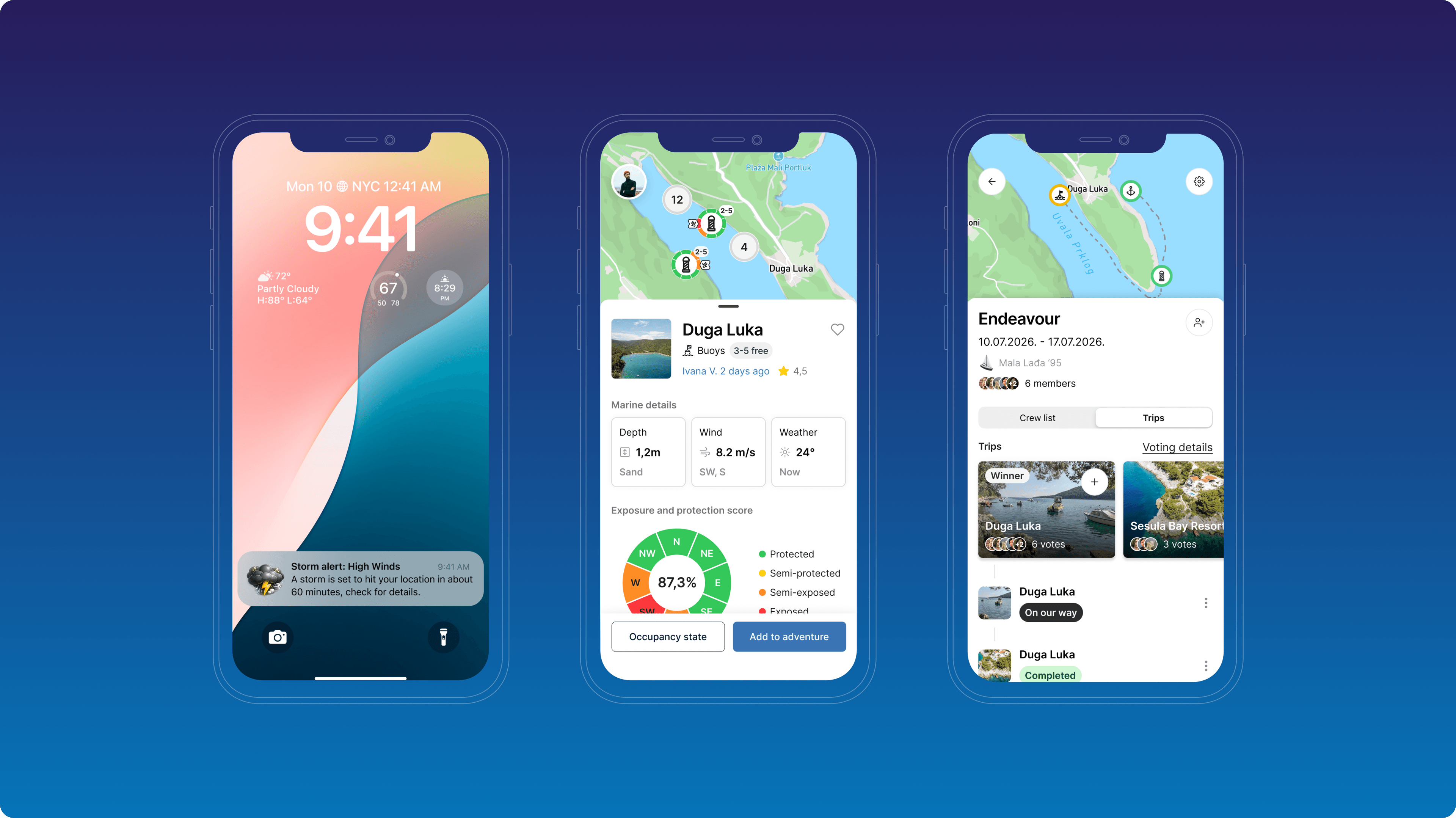
How we turned a frustration every Adriatic sailor knows — arriving to a full marina — into a research-validated, launch-ready app for the world's largest charter fleet.
- React Native
- Expo
- TypeScript
- Node.js / NestJS
- PostgreSQL
- Turborepo
- UX research
- Product strategy
- Product design
- Software architecture
- Frontend
- Backend
- Product Manager
- Full-Stack Engineers
- Product Designer
- User Researcher
Overview
Bova is a Reactor Studio venture: a mobile app that gives sailors real-time, crowdsourced occupancy for marinas, anchorages, and buoys along the Croatian Adriatic. Think Waze, for boats. In peak season, there are no reservations and no reliable way to know if there's space where you're headed — so sailors gamble on a five-hour crossing and hope. Bova removes the guesswork.
We didn't start with an app. We started with a question: is this problem real enough, and specific enough, to build a business on? Over a year of discovery, surveys, concept testing, and live demand experiments answered it before we wrote a line of production code. This case study is about that discipline — research-led product development that de-risks the bet, then ships.
Key results
The challenge
Croatia has the largest charter fleet on the planet — roughly 6,000 boats, more than triple the next country. In July and August, that fleet converges on the same coves and marinas, none of which take reservations. The culture is "first come, first served"; at popular spots like Vis, if you don't arrive by 11am, you can forget about a berth. Sailors cope with informal phone calls, WhatsApp groups with thousands of members, and local contacts they've spent years cultivating.
The obvious product — "an app that shows you where to go" — had been tried. Navily, Navionics, and others cover static destination data and navigation, but none of them answer the one question that actually causes the stress: is there space right now? The real challenge wasn't building a maps app. It was proving that sailors wanted a live, crowdsourced answer badly enough to open the app, trust it, and — the hard part — contribute back to it.
Our solution
We treated Bova as a hypothesis to be tested, not a spec to be built. Instead of committing to a full app on the strength of a good idea, we ran a sequence of increasingly real experiments — each one cheaper than the code it de-risked — until the direction was earned rather than assumed. Only then did we design and engineer the product. The result is an app scoped tightly around what the research proved sailors would actually use: getting live occupancy, and giving it back.
The strongest signal came from testing the message, not the mockup. When we put competing value propositions in front of real sailors, "real-time occupancy" didn't just win — it roughly doubled the engagement of the "hidden gems" and "trip concierge" angles. That told us where to point the entire product.
The process
Listening first
We ran seven in-depth discovery interviews across the spectrum of the market — enthusiasts, professional delivery skippers, first-year skippers, academy owners, industry veterans, and crew. Then we quantified it with a 100-person survey split across Croatian and international sailors.
The same problem rose to the top every time: finding a free berth or buoy, and the unreliable information around availability. International sailors, without local networks to lean on, felt it most acutely.
Testing the value, not the feature
Before building anything, we tested the message. We ran Facebook ad campaigns pitting three value propositions against each other: real-time occupancy, hidden-gem discovery, and a trip-concierge angle.
Real-time occupancy came out far ahead — around 30% click-through against roughly 15% and 18–20% for the alternatives. Nearly double. This is the moment the product found its focus: not a prettier map, but the live answer nobody else was giving.
A Wizard-of-Oz MVP
To test whether people would actually rely on us for this, we faked the back end with humans. We ran a WhatsApp concierge offering international skippers real-time help and bay-occupancy info — no app, just responsiveness.
It drew 46 requests and 20 real conversations, confirming that sailors would reach out for exactly this information and act on it. Demand validated, at almost zero build cost.
Designing and engineering for the season
With the bet de-risked, we built. The app is a TypeScript monorepo — an Expo / React Native client and a NestJS backend — designed around the core loop the research prioritized: seeing live occupancy and reporting it.
Reporting is engineered to be effortless: geofencing detects arrival at a destination and prompts a two-tap report, and any sailor can request a live update that pings the boats already there. Behind the map sits a purpose-built weather engine, blending ICON-EU, GFS, and METAR observations into localized forecasts and wind-protection scores for each cove.
Real-time, crowdsourced occupancy
The heart of Bova. Every marina, anchorage, and buoy carries a live availability state, reported by the sailors who are actually there — colour-coded on the map so you can read the whole coast at a glance.
Requesting an update takes one tap; providing one takes two. The more the community reports, the sharper the picture gets for everyone.
A weather engine built for the Adriatic
Generic marine forecasts are too coarse for deciding whether a specific cove is safe tonight. We built a blending pipeline — ICON-EU and GFS models corrected against real observations — that produces localized conditions and a wind-protection score per destination, so a skipper can judge shelter before committing to the crossing.
Results
Bova enters the 2026 Adriatic season as a validated product, not a hopeful one. The problem is documented across interviews, a survey, concept testing, and live-demand experiments; the value proposition was chosen by real sailors in the market, not around a table; and the app is scoped tightly around the loop the research proved. On the commercial side, a leading charter company has already signalled interest in the data the platform generates.
Research-led. Season-ready. Bova is what happens when you validate before you build.
The measure of this project isn't a launch-day metric — it's what we knew before launch day. By spending a year proving the bet in progressively real ways, we built the right product to build, and gave it the best possible odds in the water.
Visit Bova